

When facing an expensive engine repair bill, a very common question drivers ask mechanics is the serpentine belt and the timing belt the same? Because both components are made of rubber, rotate constantly, and are essential for your car to run, it is incredibly easy to confuse them.
However, mixing up these two parts can be a costly mistake. They serve entirely different purposes, are located in different parts of the engine, and have vastly different replacement costs.
In this comprehensive mechanical guide, we will answer exactly is the serpentine belt and the timing belt the same, explore what each one does, and explain why failing to maintain them can lead to catastrophic engine damage.
The Short Answer: Is the Serpentine Belt and the Timing Belt the Same?
To get straight to the facts, the answer to is the serpentine belt and the timing belt the same is a definitive no.
They are two distinct, independent components. The serpentine belt is an exterior drive belt that powers peripheral engine accessories. The timing belt, on the other hand, is a heavy-duty internal synchronizer that keeps the core internal mechanics of the engine perfectly timed.
While a broken serpentine belt will leave you stranded on the side of the road, a broken timing belt can completely destroy your engine beyond repair.
Understanding Functions: What Do They Actually Do?
To truly understand why the answer to is the serpentine belt and the timing belt the same is no, we need to look at their specific jobs.
The Exterior Accessory Drive
If you have read our foundational guide on what is a serpentine belt, you know that it acts as a power delivery system. It takes the rotational energy from the engine’s crankshaft and delivers it to the alternator, power steering pump, water pump, and air conditioning compressor.
The Internal Engine Synchronizer
The timing belt has a much more precise job. It connects the engine’s crankshaft (which moves the pistons up and down) to the camshaft (which opens and closes the engine’s valves). It ensures that the valves open at the exact millisecond the pistons move, preventing them from violently colliding.
For a deeper dive into how engine timing works, you can check out trusted automotive engineering resources like Edmunds’ Car Maintenance Guide.
Visual Differences: Is the Serpentine Belt and the Timing Belt the Same Appearance?
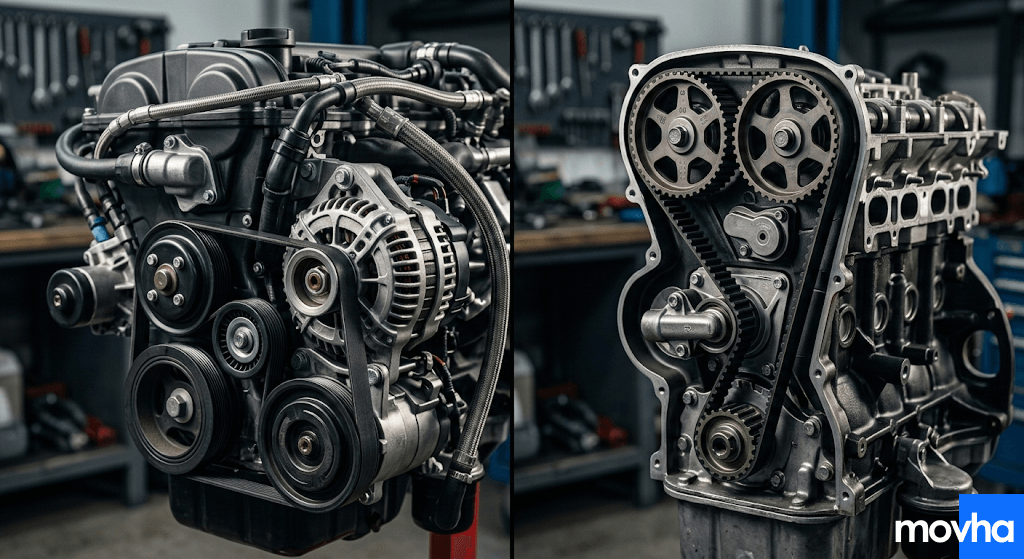
If you pop the hood of your car, the visual differences are immediately obvious.
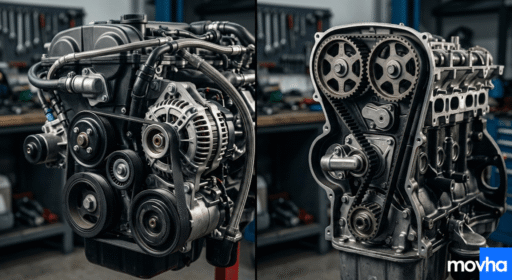
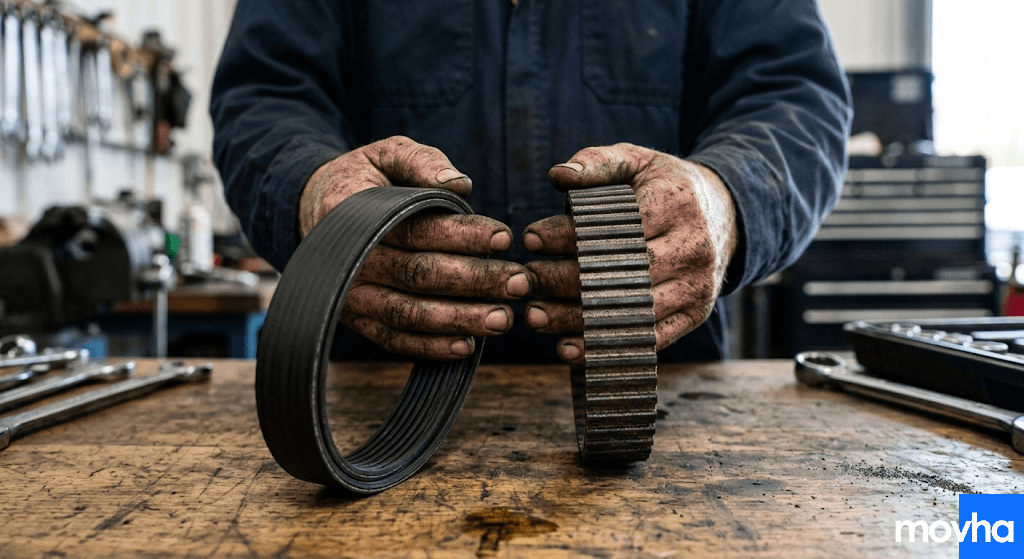
The serpentine belt is highly visible. It is a long, winding black rubber loop located on the front or side of the engine block. It features lengthwise grooves (ribs) on the underside to grip smooth pulleys.
The timing belt is usually hidden. It is located inside the engine block behind a protective metal or plastic timing cover to keep it safe from dirt and oil. Visually, it looks like a heavy-duty track with thick horizontal teeth (cogs) designed to lock securely onto the gears of the crankshaft and camshaft.
What Happens When They Break?
Another major difference to consider when asking is the serpentine belt and the timing belt the same relates to the consequences of a failure.
If your serpentine belt snaps, you will lose power steering, your battery will stop charging, and your engine will begin to overheat. However, if you pull over immediately and turn off the engine, your car will not suffer permanent damage. You can read more about these exact symptoms in our article exploring what does a serpentine belt do.
If your timing belt snaps while driving, the results are devastating. The pistons will crash into the open valves, bending the valves, destroying the cylinder head, and potentially requiring a complete engine replacement.
Maintenance and Repair Costs
Because their functions and locations are so different, the repair bills are drastically different as well.
Replacing a serpentine belt is quick, easy, and affordable. If you are budgeting for this, you can review our cost guide on how much to replace serpentine belt components, which usually totals under $200.
Replacing a timing belt is a labor-intensive, complex job that requires taking apart a significant portion of the engine. A professional timing belt replacement often costs between $500 and $1,500, depending on the vehicle model and the labor rates in your area.
Conclusion
So, is the serpentine belt and the timing belt the same? Absolutely not. While both are critical rubber belts that keep your car moving, their roles are completely distinct.
The serpentine belt powers your comfort and accessory systems from the outside, while the timing belt protects the life of your engine from the inside. Knowing the difference between the two will help you communicate better with your mechanic and stay on top of your vehicle’s preventative maintenance schedule.
Frequently Asked Questions (FAQs)
Do all cars have both a serpentine belt and a timing belt?
No. While almost all modern cars have a serpentine belt, many vehicles use a metal “timing chain” instead of a rubber timing belt. Timing chains are designed to last the lifetime of the engine and usually do not require routine replacement.
How often should a timing belt be replaced?
While serpentine belts last around 60,000 to 100,000 miles, timing belts usually need to be replaced between 70,000 and 100,000 miles, depending heavily on the manufacturer’s strict recommendations.
Is the serpentine belt and the timing belt the same price to fix?
No, they are vastly different in price. A serpentine belt job is usually under $200, whereas a timing belt replacement is a major mechanical procedure that can cost over $1,000.
Can I replace a timing belt myself?
While many people replace their own serpentine belts, replacing a timing belt is not recommended for beginners. If you set the timing incorrectly by even a single tooth, you will destroy your engine the moment you turn the key.
What are the signs of a bad timing belt?
Unlike a serpentine belt that squeals, a timing belt often gives no warning before it snaps. However, you might occasionally hear a ticking noise from the engine, or the car may misfire and run rough if the belt has stretched and jumped a tooth.